
The chemistry behind DeeeMines
Four years of research at the Institut de Recherche de Chimie Paris, a doctoral thesis, a patent and a peer-reviewed paper. Here is what the process does, and the evidence that it works.
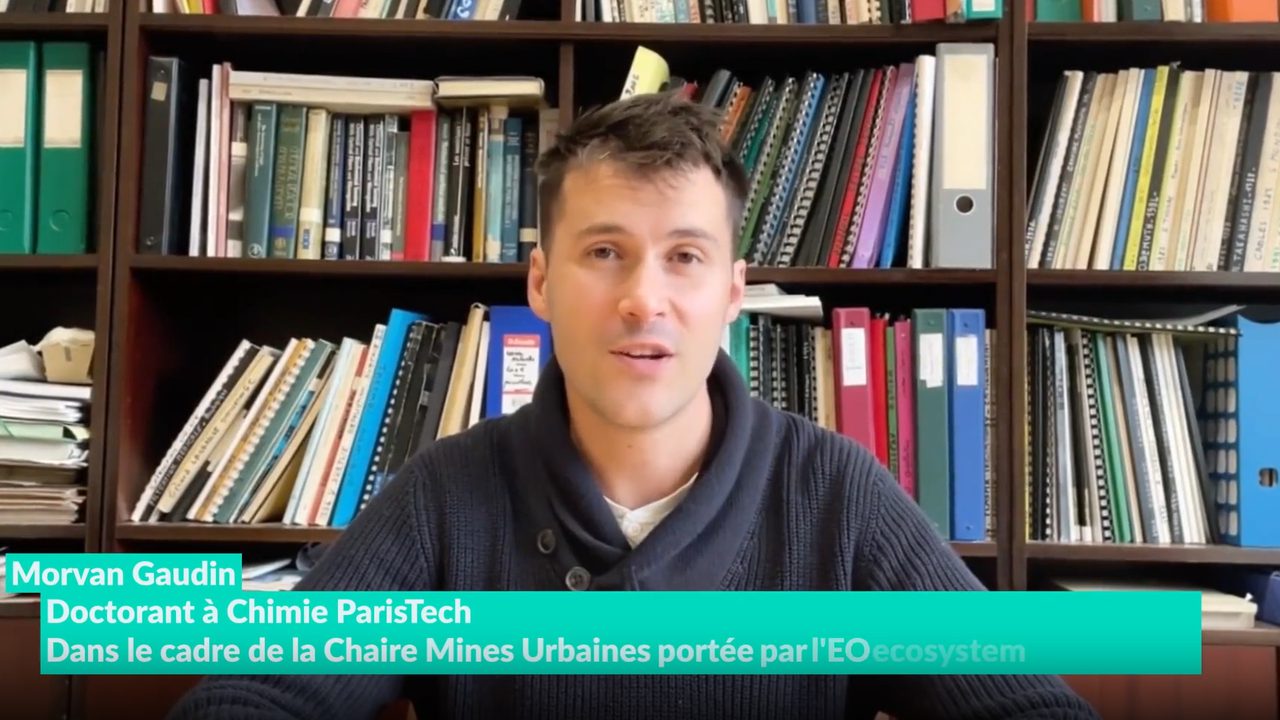
Morvan Gaudin presents the research behind the process, carried out at the Institut de Recherche de Chimie Paris within the Urban Mining Chair, with the support of the producer responsibility organisation ecosystem.
Additives trapped inside the material…
The plastics in electrical and electronic equipment contain brominated flame retardants, combined with antimony trioxide, which makes them far more effective. Both are spread through the polymer matrix, not laid on the surface.
No industry today can separate them out. These plastics therefore go to incineration, along with the antimony and the bromine they hold.
… released by a patented process
Everything happens at room temperature and atmospheric pressure, with no heating and no pressure.
The shredded material goes through three successive solvents. The first dissolves the polymer and frees the additives trapped in the material. The second, a complexing agent, selectively captures the antimony, and the brominated compounds are extracted in turn. The third precipitates the polymer back out, stripped of its additives.
Shredding
The waste arrives in pieces of every size. Shredding gives an even fraction, the condition for a stable yield.
Dissolution
The first solvent dissolves the polymer. The additives, until then trapped in the material, become reachable.
Selective extraction
The second selectively captures the antimony oxide. The brominated compounds are extracted in turn.
Precipitation
The third precipitates the cleaned polymer back out, recovered solid and dried. The regenerated solvents go into the next cycle.
Three products recovered from a waste stream
Antimony is our priority. The bromine and the polymer come out of the same operation and will be valorised in turn.
Antimony Priority
The antimony oxide extracted from the plastics is sold as it is or converted to suit the intended use. A traceable material, produced in Europe.
Brominated compounds
Isolated intact and separated from the polymer. Some of them are persistent organic pollutants and need to be transformed before any reuse.
Polymers
Stripped of their additives, they can go back into the plastics industry instead of up in smoke.
The 98 % yield is reached on shredded material from real electronic waste, supplied by our industrial partners.
The brominated compounds are extracted in turn. It is not only the antimony that leaves the plastic.
The recovered polymer holds fewer pollutants than the regulatory limit allows, and can go back into the industry.
Published, and peer-reviewed
The process is not a laboratory promise.
It has been reviewed by the scientific community, validated, and protected by
a patent.
-
Thesis
Developing innovative processes to decontaminate brominated plastics from waste electrical and electronic equipment by extracting antimony oxide and organobrominated molecules
Read the thesis →Research by Morvan Gaudin, defended on 3 December 2024 at Université Paris Sciences et Lettres. Carried out at the Institut de Recherche de Chimie Paris within the Urban Mining Chair, with the support of the producer responsibility organisation ecosystem.
-
Paper
Antimony Trioxide Extraction from E-Waste Brominated Flame-Retardant Laden Plastics by Simultaneous Liquid–Liquid Extraction and Leaching
Read the paper →Morvan Gaudin, Vincent Semetey, Frédéric Rousseau and Grégory Lefèvre, in ACS Sustainable Resource Management, 2025.
-
Patent
Patented process, published in 2025
From the laboratory to the pilot
The process is leaving the laboratory. A pilot is in preparation.